Lesley A. Ward, Dennis S.W. Lee, Anshu Sharma, Angela Wang, Ikbel Naouar, Xianjie I. Ma, Natalia Pikor, Barbara Nuesslein-Hildesheim, Valeria Ramaglia, and Jennifer L. Gommerman
Abstract
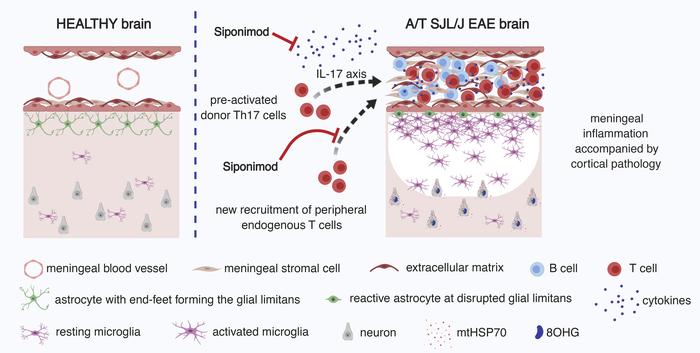
Subpial demyelination is a specific hallmark of multiple sclerosis (MS) and a correlate of disease progression. Although the mechanism(s) that mediate pathogenesis in the subpial compartment remain unclear, it has been speculated that inflammation in the overlying meninges may be associated with subpial injury. Here we show that adoptive transfer of proteolipid protein-primed Th17 cells into SJL/J recipient mice induces subpial demyelination associated with microglial/macrophage activation, disruption of the glial limitans and evidence of an oxidative stress response. This pathology was topologically associated with foci of immune cells in the meninges and occurred in the absence of measurable anti-MOG IgM or IgG antibodies. To test the role of brain-infiltrating leukocytes on subpial injury, we modulated sphingosine 1-phosphate (S1P) receptor1,5 activity with BAF312 (siponimod) treatment. Administration of BAF312, even after adoptively transferred T cells had entered the brain, significantly ameliorated clinical EAE and diminished subpial pathology, concomitant with a selective reduction in the capacity of transferred T cells to make Th17 cytokines. We conclude that sustained subpial cortical injury is associated with the capacity for brain-resident T cells to produce Th17 cytokines, and this pathological process occurs in an S1P receptor1,5-dependent manner.
Graphical Abstract
Supplemental Material
Version history
Version 1 (December 10, 2019): In-Press Preview
Source: JCIinsight